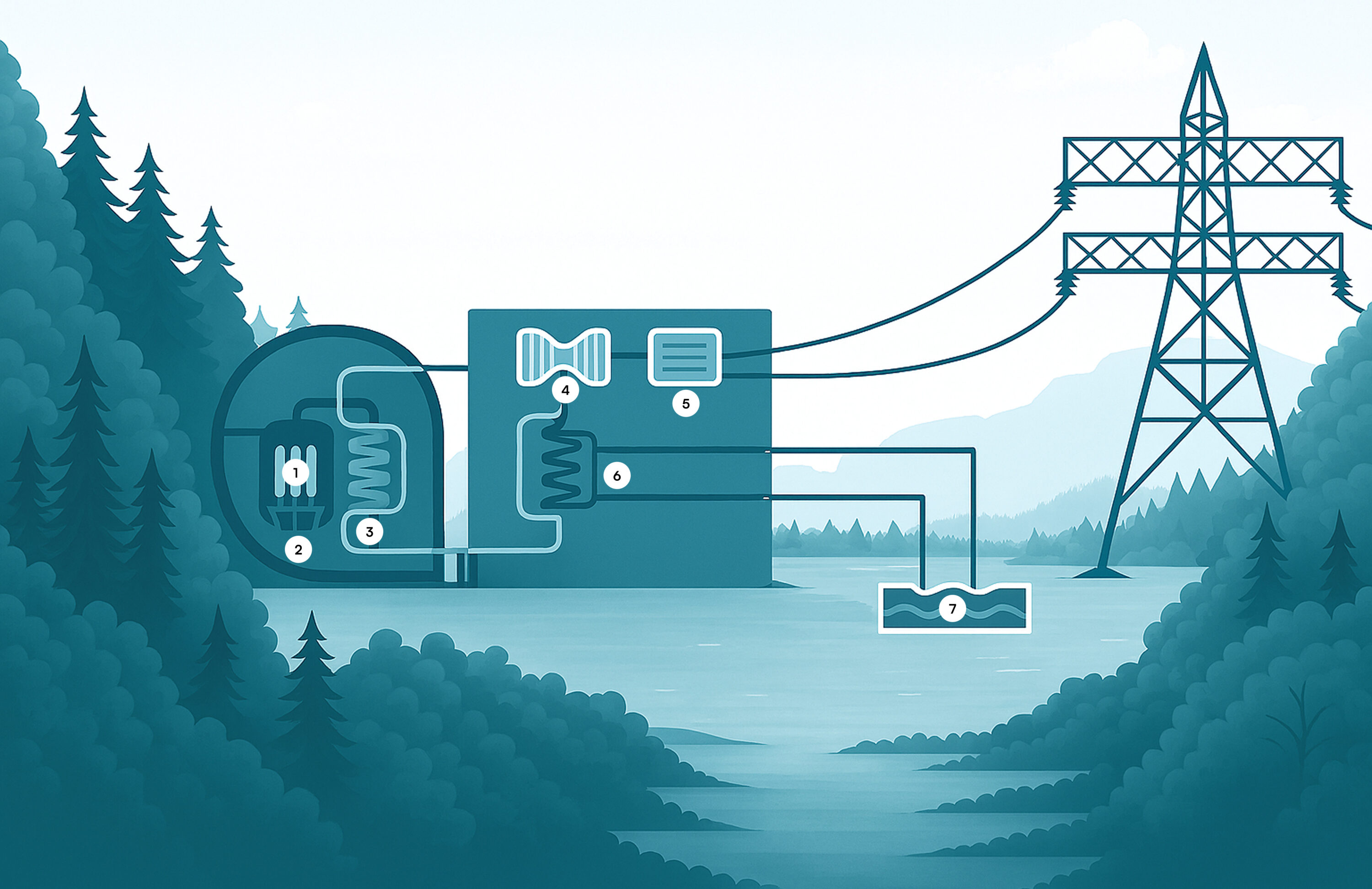
A nuclear power plant uses the heat released during the fission of nuclear fuel, such as uranium, to generate electricity. This works as follows: Inside the plant, uranium oxide rods are placed in a vessel filled with water (1 and 2). When the uranium nuclei in these rods split, heat is released, causing the water to become hot. This hot water flows to a steam generator (3), where it transfers its heat to a second water circuit that produces steam. The steam drives a turbine (4), which drives a generator (5) to produce electricity. After the turbine, the steam condenses back into water in a condenser (6) by transferring heat to cooling water from the cooling water system (7). Nuclear power plants have three separate, closed circuits, so the water from the reactor does not enter the turbine or cooling facilities. This keeps the primary (reactor) circuit separate and prevents the spread of radioactive substances. All in all, this process leads to safe, stable, and efficient electricity production.
An illustration of this process is shown below.